
The Persona Pattern — How to Get Expert-Level Answers from Any AI
Published on April 16, 2026
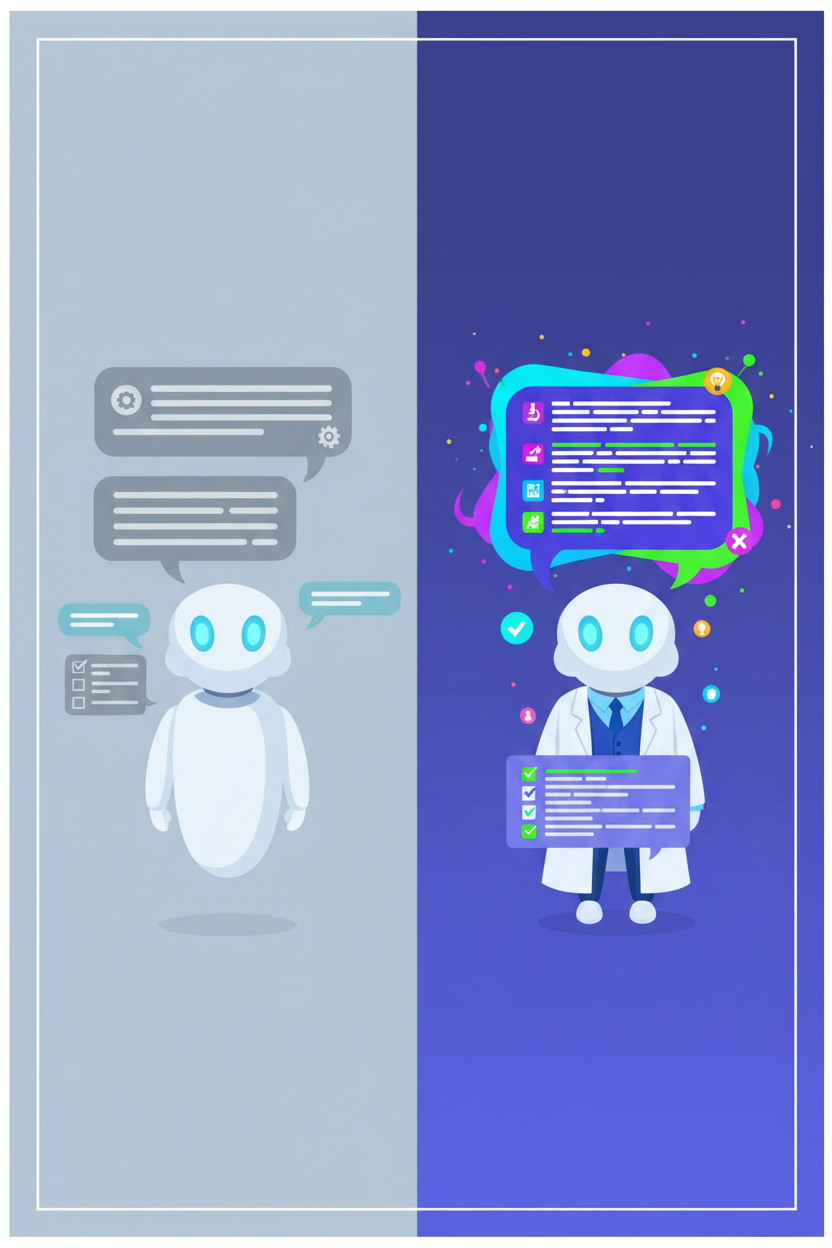
You ask ChatGPT a question and the answer is... fine. But flat. Generic. It reads like a reheated Wikipedia page. You feel like you're talking to a polite intern who knows a bit about everything, but nothing in depth.
The problem isn't the AI. It's that you're talking to it like a search engine instead of talking to it like a collaborator.
There's a simple technique that radically transforms the quality of responses: the Persona Pattern. Instead of asking a question into the void, you start by telling the AI who it is, what it knows, and what you expect from it. In a single sentence, you go from a generalist assistant to a dedicated expert.
In this article, you'll learn exactly how to write an effective persona, the mistakes to avoid, and how this technique works differently depending on the model you use — ChatGPT, Claude, Gemini or Mistral.
This article is part of our prompt engineering series
It's a deep dive into technique #2 from our complete guide: How to Write Good Prompts. If you're just starting out, begin with the full guide.
What Is the Persona Pattern?
The Persona Pattern means assigning a specific role to the AI before asking your question. Instead of requesting information "into the void", you start by defining the expert profile the AI should embody.
The basic formula:
You are a [position] specialized in [domain]. You will help me [goal].
Real example:
You are a senior recruiter specialized in tech hiring. You will help me rewrite my resume for a project manager position.
Why Does It Work?
AI has been trained on billions of texts written by humans — including medical papers, legal manuals, technical discussions between developers, and financial analyses. All that knowledge is there, but by default, the AI responds in "generalist assistant" mode.
When you assign a role, you activate a specific subset of that knowledge. It's like asking a versatile musician to play jazz rather than just "music": quality and relevance go up immediately.
Without a persona, the AI gives you the most probable answer. With a persona, it gives you the most relevant answer for your context.
The Difference in Practice: Before and After
The best way to understand the impact of the Persona Pattern is to compare. Here's the same question asked with and without a persona, in everyday situations:
| Situation | Prompt without persona | Prompt with persona |
|---|---|---|
| Improve your resume | "Improve my resume" | "You are a senior recruiter with 15 years of experience in tech. Help me rewrite my resume for a project manager position at a SaaS startup." |
| Secure a website | "How do I secure my website?" | "You are a senior developer specialized in cybersecurity for e-commerce. Identify the 5 most common vulnerabilities for a Shopify online store." |
| Negotiate a raise | "How do I ask for a raise?" | "You are a professional development coach. Guide me through preparing my salary negotiation, considering my 3 years of seniority and my recent success on project X." |
| Analyze a lease | "Explain this contract to me" | "You are a lawyer specialized in real estate law. Analyze this rental lease and flag any unusual or potentially disadvantageous clauses for the tenant." |
| Create content | "Give me LinkedIn post ideas" | "You are a social media manager specialized in B2B SaaS. Suggest 5 LinkedIn posts to promote a multi-model AI tool to tech decision-makers." |
In every case, the prompt with a persona produces a more precise, more actionable, and better-adapted response. The difference isn't subtle — it's radical.
The 3 Elements of an Effective Persona
A good persona rests on three pillars. If one is missing, the result is noticeably weaker.
1. The Position — Who Is the Expert?
Be specific. "An expert" means nothing. "A senior recruiter with 15 years of experience in tech" activates a precise mental profile.
| Too vague | Well-calibrated |
|---|---|
| A marketing expert | A B2B SaaS marketing director with 10 years of growth experience |
| A doctor | A general practitioner specialized in sports medicine |
| A developer | A senior fullstack developer expert in React and Node.js |
| A lawyer | An employment lawyer representing employees |
2. The Domain — In What Context?
The domain of specialization narrows the response field and makes it relevant. "Cybersecurity" is broad. "Cybersecurity for Shopify e-commerce" is precise. The more targeted the domain, the more actionable the response.
3. The Goal — What Do You Want to Achieve?
Without a goal, the AI doesn't know which direction to go. "Help me rewrite my resume" is a goal. "Help me rewrite my resume for a project manager position at a B2B SaaS startup" is a better goal.
The Brief Test
Re-read your persona as if it were a brief sent to a human freelancer. If there's not enough information for them to start working, your persona isn't specific enough.
Mistakes That Ruin the Persona Pattern
Mistake 1: The Vague Persona
❌ "You are an expert. Help me."
The AI can't activate specialized knowledge if you don't give it anything specific. It's like telling a musician "play music" — they'll play something, but not necessarily what you want.
Mistake 2: The Contradictory Persona
❌ "You are a lawyer specialized in employment law. Give me medical advice about my back pain."
If the role and the question don't match, the AI is pulled between the two and produces a mediocre result. Each persona must be consistent with the task at hand.
Mistake 3: Forgetting the Goal
❌ "You are a senior data scientist."
And then what? Without a goal, the AI doesn't know what you expect. It might introduce itself, or ask what you want — but you've wasted an exchange for nothing.
Mistake 4: Switching Personas Mid-Conversation
If you start with a "tech recruiter" persona and then ask for legal advice mid-conversation, the AI will try to juggle both contexts. Result: a confused response.
The golden rule: one persona = one conversation. If you change topics, start a new conversation.
Advanced Techniques
Combining the Persona with Other Techniques
The Persona Pattern is powerful on its own, but it becomes formidable when combined with other prompting techniques:
Persona + Response Format:
You are a sports nutritionist. Give me a weekly meal plan as a table with columns: day, breakfast, lunch, dinner, snack.
Persona + Examples (Few-Shot):
You are a B2B copywriter. Here's an example of the tone I expect: "Stop wasting 3 hours a day in your emails. Our tool sorts them for you." Write 5 hooks in this same style for a project management tool.
Persona + Chain of Thought:
You are a strategy consultant. Analyze this situation step by step: first the strengths, then the weaknesses, then the opportunities, then the threats.
Learn more about these techniques
Find the details of the Few-Shot Pattern and the Chain of Thought in our complete guide.
Multi-Persona: Making Experts Debate
Advanced technique: ask the AI to embody multiple experts in succession and confront their viewpoints.
Analyze this business plan from three perspectives:
- A VC investor looking for scalability
- An accountant assessing financial viability
- A potential customer evaluating the value proposition
For each perspective, give the 3 positives and the 3 risks identified.
This technique is particularly powerful for complex decisions where a single viewpoint isn't enough.
Persona by Model: Each AI Reacts Differently
This is a point that most guides ignore: not all models react the same way to the same persona.
| Model | Behavior with persona |
|---|---|
| ChatGPT (GPT-5) | Follows personas very faithfully, with a tendency to be verbose. Works great for creative and editorial roles. |
| Claude | Excellent for personas that require nuance and analysis. Respects the boundaries of the role well and admits when it's outside its domain. |
| Gemini | Strong on technical and factual personas. Tends to bring in sources and data. |
| Mistral | Responsive and concise. Good for personas that require direct, structured answers. |
The Haloon trick: test the same persona across multiple models
On Haloon, the Reprompt button lets you send the same message with the same persona to another model in one click. It's the fastest way to find the model that best interprets your persona for a given task.
Ready-to-Use Template
Here's a template you can copy and adapt to any situation:
You are a [SPECIFIC POSITION] with [X YEARS OF EXPERIENCE] specialized
in [SPECIFIC DOMAIN].

Your expertise includes: [2-3 KEY SKILLS].

You will help me [SPECIFIC GOAL].

Constraints:
- [CONSTRAINT 1: tone, format, length...]
- [CONSTRAINT 2: target audience, level of detail...]

If you're not certain about something, say so clearly rather than guessing.
Filled-in example:
You are a senior SEO consultant with 12 years of experience specialized
in search optimization for B2B SaaS.

Your expertise includes: technical SEO, content strategy,
and conversion rate optimization.

You will help me create a content plan for the next 3 months
for a multi-model AI tool.

Constraints:
- The plan should target transactional-intent keywords
- Articles must be achievable by a one-person team
- Prioritize by potential traffic impact

If you're not certain about something, say so clearly
rather than guessing.
Summary
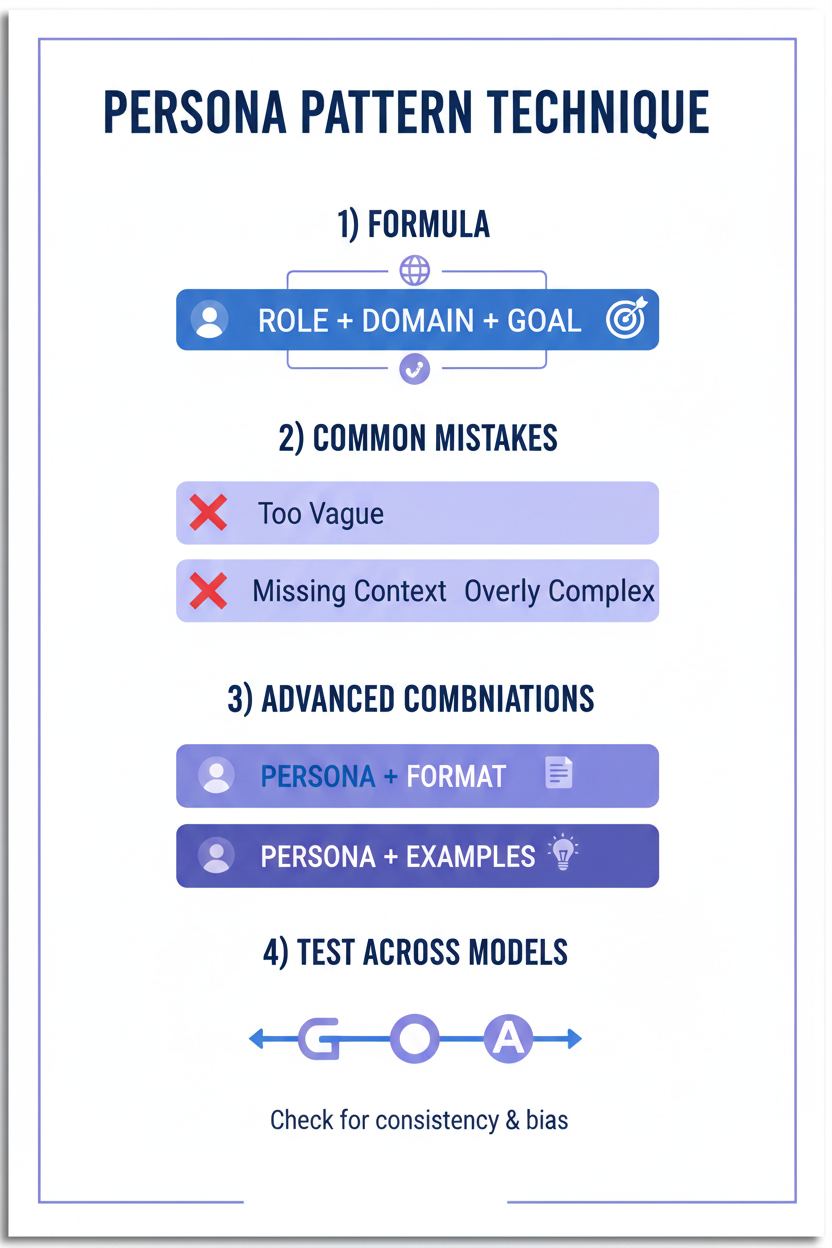
| Concept | Key takeaway |
|---|---|
| The Persona Pattern | Assign a specific role to the AI before asking your question |
| The formula | Position + Domain + Goal |
| The main mistake | Being too vague: "you are an expert" isn't enough |
| The advanced technique | Combine the persona with format, examples, or chain of thought |
| Multi-model | Each AI reacts differently — test the same persona across models |
Go further
Find all 9 other prompting techniques in our complete guide: How to Write Good Prompts.